How to Manage Airline Disability Problems: A Master Guide for 2026
Commercial aviation exists as a marvel of highly synchronized engineering and logistical precision, yet it remains one of the most significant friction points for the disability community. The transition from terrestrial autonomy to the pressurized, cramped, and often standardized environment of a passenger aircraft forces a collision between human biological diversity and rigid operational protocols. For the traveler with a disability, the aircraft cabin is not merely a transport tube; it is a high-stakes environment where the failure of a single policy or piece of equipment can lead to physical injury, social exclusion, or the total loss of a $30,000 mobility asset.
Navigating this sector requires a sophisticated understanding of “Inter-jurisdictional Compliance.” Airlines operate across borders where the Air Carrier Access Act (ACAA) might clash with the European Regulation (EC) No 1107/2006 or local civil aviation authorities. This complexity creates an “Information Gap” that passengers are often forced to fill themselves. To succeed in this environment, one must move beyond the role of a “passenger” and become a “Logistics Coordinator,” overseeing the chain of custody for their equipment and their own physical safety across multiple touchpoints from the check-in counter and the security checkpoint to the jet bridge and the cargo hold.
As we progress through 2026, the industry is witnessing a shift toward “Technological Accountability,” with new mandates for wheelchair handling and the tracking of mobility aids. However, the fundamental challenge remains the “Manual Interface”; the moment a human ramp agent must handle a complex mechatronic device they have never seen before. This article serves as an authoritative reference for deconstructing the risks of air travel and providing a framework for operational resilience. It is an analytical examination of how to maintain sovereignty within a system that was historically designed for a narrow, able-bodied archetype.
Understanding “how to manage airline disability problems.”
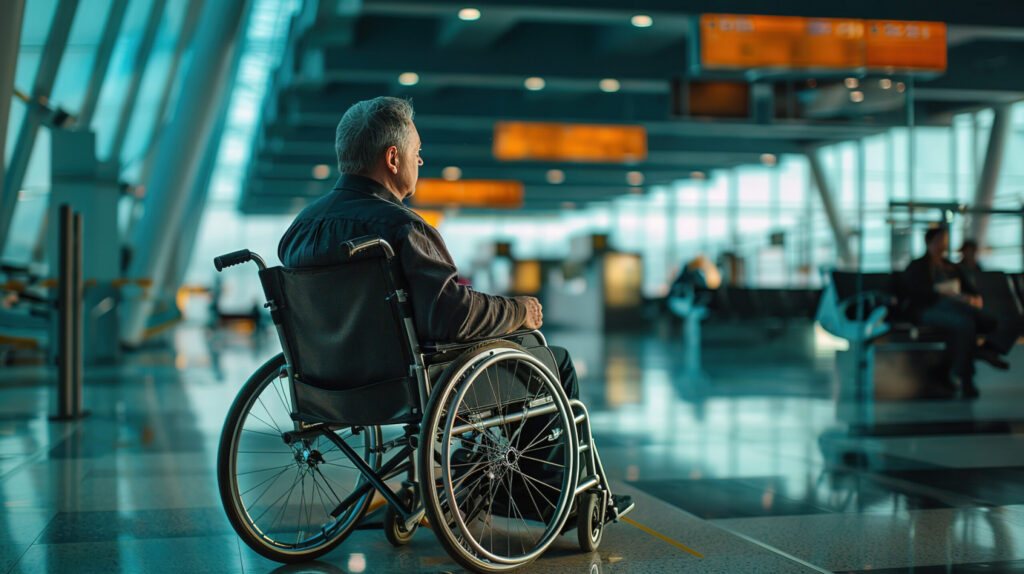
To master how to manage airline disability problems, one must first acknowledge the “Protocol-Reality Gap.” Airlines frequently present a polished front of accessibility through their websites, citing compliant restrooms and priority boarding. However, the operational reality is often defined by “Staffing Attrition” and a lack of standardized training for third-party contractors who handle ground operations. Managing these problems is not about quoting laws at a gate agent; it is about “Information Dominance,” having the technical specifications, the legal precedents, and the physical documentation ready before a conflict arises.
A common misunderstanding is the belief that airline liability for damaged equipment is a straightforward insurance claim. In reality, under the Montreal Convention, liability limits for international flights can be significantly lower than the replacement cost of a custom power wheelchair. Therefore, managing problems includes “Fiscal Pre-emption,” knowing when to carry independent insurance and how to document the condition of a device in a legally irrefutable way. Oversimplification often leads travelers to trust the “Special Assistance” desk blindly, failing to realize that these agents often lack the authority to override weight limits or battery safety protocols determined by the pilot in command.
Furthermore, the “Sensory and Cognitive” aspects of air travel are often sidelined in favor of physical mobility. Managing disability problems in aviation requires an audit of the “Total Environment.” This includes the high-decibel noise of terminals, the olfactory triggers of cabin air, and the executive functioning required to navigate gate changes. A resilient plan treats “Sensory Regulation” as being just as critical as “Physical Access,” ensuring that the traveler’s nervous system is as protected as their mobility device.
Deep Contextual Background: The Legislative and Structural Shift
The history of aviation access has moved from “Discretionary Assistance” to “Regulated Rights.” Before the 1986 Air Carrier Access Act in the United States, airlines could (and did) refuse passage to individuals with disabilities based on arbitrary safety concerns or the lack of a traveling companion. The legislation forced a shift toward “Individualized Assessment,” but the physical infrastructure of aircraft’s narrow aisles and inaccessible lavatories remained largely stagnant for decades.
In the 2020s, we have entered the “Era of Accountability.” High-profile cases of wheelchair destruction and physical injuries during transfers have triggered a wave of regulatory scrutiny. In 2026, we are seeing the emergence of the “Digital Chain of Custody.” Airlines are beginning to use IoT sensors to track the orientation and G-forces applied to wheelchairs in cargo holds. However, we are still in a “Transition Period” where the technology is available, but the human training remains inconsistent. The modern traveler is navigating this “Gap,” using 2026 tools to solve 1990s-era mechanical problems.
Conceptual Frameworks for Aviation Resilience
To evaluate risks and manage outcomes, travelers should apply these three mental models:
1. The “Chain of Custody” Framework
This model treats the mobility device as a high-value industrial asset. Every time it changes hands from the traveler to the gate agent, from the gate to the ramp, and from the ramp to the cargo hold, a “Handover Audit” must occur. If the chain is broken, the risk of damage increases exponentially.
2. The “Captain’s Authority” Model
In aviation, the Pilot in Command (PIC) has the final legal authority over the safety of the aircraft. If a pilot believes a specific battery is unsafe or a device’s weight affects the “Weight and Balance” of a small jet, they can deny boarding. Managing this requires “Technical Diplomacy,” providing the pilot with manufacturer-certified safety data that settles the concern immediately.
3. The “Decoupling of Needs” Model
This framework separates the traveler’s physical needs (transfers, seating) from their equipment’s needs (protection, charging). By managing these as two separate logistical streams, the traveler can focus on their own regulation while ensuring their “mechanical identity” is being handled according to a strict, pre-written script.
Key Categories of Failure and Strategic Trade-offs
Aviation problems are generally segmented by the “Phase of Flight.”
| Category | Primary Failure Mode | Strategic Trade-off | Best Prevention Method |
| Ground Logistics | Denied boarding due to weight/battery | Speed vs. Verification | Pre-trip “Clearance to Fly” |
| The Transfer | Physical injury during the “Aisle Chair” move | Privacy vs. Safety | Use of personal slings/harnesses |
| Cargo Handling | Structural/Electronic damage to the device | Portability vs. Durability | “Hardening” the device for transit |
| In-Flight Access | Lavatory inaccessibility/Dehydration | Comfort vs. Health | Strategic “Dry” travel vs. Catheterization |
| Cognitive/Sensory | Overwhelm during delays | Spontaneity vs. Regulation | “Quiet Zone” pre-mapping |
| Arrival/Recovery | Delayed return of the device at the gate | Convenience vs. Advocacy | “Last-on, First-off” tagging |
Decision Logic: The “Gate-Check” vs. “Cabin Storage” Choice
Under many regulations, travelers have the right to store a folding manual wheelchair in the cabin if space is available. The strategic trade-off is “Security vs. Space.” Storing in the cabin eliminates the “Cargo Risk” but takes up precious overhead or closet space that may lead to social friction with other passengers or crew. The decision logic should favor “Cabin Storage” for any device with sensitive carbon fiber or high-end wheels.
Real-World Scenarios: Crisis and Resolution
The “Battery Safety” Stand-off
-
The Context: A traveler with a lithium-powered folding chair is told at the gate that the battery “looks too big” and cannot fly.
-
The Pivot: The traveler produces a “Battery Compliance Portfolio” containing the UN 38.3 test certificate and a copy of the ICAO Technical Instructions.
-
The Outcome: The gate agent consults the “Red Book” (dangerous goods manual), sees the compliance, and the traveler boards. Without this data, the traveler would have been stranded.
The “Damaged-on-Arrival” Response
-
The Context: Upon arrival, the traveler’s power chair joystick is snapped off.
-
The Failure: The traveler leaves the airport hoping to “sort it out later.”
-
The Correct Management: Refusing to leave the jet bridge until a “Property Irregularity Report” (PIR) is filed and a loaner chair is provided. This forces the airline to accept immediate liability before the “Chain of Custody” is officially ended.
Planning, Cost, and Resource Dynamics
The “Economics of Aviation Advocacy” requires an investment in “Redundancy.”
Range-Based Resource Comparison
| Resource | Low-Cost (Risky) | Managed (Resilient) | Value Impact |
| Insurance | Standard Credit Card | Specialized Mobility Rider | $30k Asset Protection |
| Direct Costs | Budget Carrier | Full-Service Legacy Carrier | Higher staff-to-passenger ratio |
| Preparation | 1 Hour (Booking) | 10 Hours (Auditing/Docs) | Prevents “Trip Failure” |
| Equipment | Standard Consumer Grade | “Travel-Hardened” Modular | Reduces repair downtime |
The “Opportunity Cost” of Short Layovers: A common mistake in managing aviation problems is booking tight connections. For a wheelchair user, a 1-hour layover is a “High-Probability Failure.” It takes 20 minutes to deplane and 20 minutes to board. This leaves 20 minutes for the ground crew to move a 300-pound chair between planes—a task that often takes 45 minutes. A “Resilient Itinerary” mandates 2-hour minimum layovers.
The Tool Stack: Strategies for Equipment Integrity
-
Air-Tag Redundancy: Placing multiple Bluetooth trackers in the frame and the battery pack to ensure the device is on the same plane as the user.
-
Custom Instruction Placards: Laminated, multi-lingual diagrams attached to the chair showing exactly where to lift and how to put the motors in “neutral.”
-
Removable Components Bag: Always remove the joystick, headrest, and cushions and carry them into the cabin as “Medical Equipment” (which does not count toward carry-on limits).
-
The “Safety Sling”: Carrying a personal transfer sling (like a slide sheet) to ensure that the staff is lifting the sling, not the traveler’s limbs, reducing injury risk.
-
Digital Decibel Meters: Using smartphone apps to monitor cabin noise and utilizing “Active Noise Canceling” (ANC) headsets to prevent sensory fatigue.
-
Pressure Map Sensors: For long-haul flights, using thin, portable sensors to monitor skin pressure while sitting in a non-customized airplane seat to prevent pressure sores.
Risk Landscape: The Taxonomy of Aviation Failure
The “Systemic Cascade” of Delay
In aviation, one small problem (a broken elevator at the gate) often triggers a “Cascade.” The traveler is late to the gate, they are “Boarded Last,” the crew is rushed, the wheelchair is “Man-handled” into the cargo hold, and the battery is not properly secured. Managing the problem requires “Interrupting the Cascade” at the first point of friction—even if it means delaying the flight to ensure the equipment is safe.
The “Hidden Disability” Paradox
Travelers with invisible disabilities (autism, chronic pain, PTSD) face the risk of “Service Skepticism.” If they do not “look” disabled, staff may be less patient with cognitive processing delays. The management strategy here is “Pre-emptive Disclosure” through the “Sunflower Lanyard” program or the airline’s “Special Service Request” (SSR) codes.
Governance, Maintenance, and Long-Term Adaptation
Frequent travelers must view their aviation strategy as a “Living System.”
The “Aviation Readiness” Checklist
-
Monthly: Update the “Technical File” for all devices (new firmware, new battery specs).
-
Pre-Flight (72h): Call the “Accessibility Desk” to confirm the aircraft type (verify aisle width and cargo door dimensions).
-
During Flight: Document the names of the “Lifting Team” and the condition of the device at every transition.
-
Post-Flight: Conduct a “Mechanical Audit.” Did any bolts loosen during the vibration of the flight?
Measurement: Tracking Navigational Success
-
Leading Indicator: “Documentation Completeness.” The percentage of flights where all battery and weight data were submitted and confirmed 48 hours prior.
-
Lagging Indicator: “Mean Time to Repair (MTTR).” If a device is damaged, how many days does the airline take to resolve it? A high MTTR suggests a need to change carriers.
-
Qualitative Signal: “Recovery Speed.” How quickly did the traveler return to their “Baseline Regulation” after deplaning?
Common Misconceptions and Oversimplifications
-
Myth: “The airline will provide a wheelchair.”
Correction: They provide a “Transit Chair” (aisle chair), which is often uncomfortable and lacks postural support. It is a transport tool, not a mobility tool. -
Myth: “I have to wait until everyone else gets off.”
Correction: While often the practice, if you have a tight connection or a medical need, you have the right to request priority deplaning if your equipment is ready. -
Myth: “The ADA covers me globally.”
Correction: The ACAA covers U.S. carriers and foreign carriers flying into/out of the U.S. Once you are on a domestic flight in a foreign country, you are under their local laws. -
Myth: “Crew can help me with my medication/bathroom.”
Correction: Flight attendants are not medical caregivers. They can help you to the door of the lavatory, but they cannot assist with “personal functions” inside.
Conclusion:
Mastering how to manage airline disability problems is an exercise in “Professional Logistical Resilience.” It requires a shift from being a “Guest” to being an “Overseer” of a complex movement. In 2026, the tools for transparency tracking, digital documentation, and real-time advocacy are more powerful than ever, but they are only effective when integrated into a disciplined, systemic approach. The goal of every journey is not just arrival, but “Arrival with Integrity,” ensuring that both the traveler and their essential equipment emerge from the pressurized environment of flight ready to engage with the world. The future of accessible flight is not just in the hands of the airlines, but in the rigorous preparation of the travelers themselves.